
IFIT / Welcome to The Institute for Integrated Transitions
Ensuring local pathways to durable peace and democracy
The Institute for Integrated Transitions (IFIT) is an international non-governmental organisation dedicated to helping fragile and conflict-affected states achieve more effective negotiations and transitions out of war, crisis or authoritarianism. IFIT’s core work is to serve as an expert resource on integrated policy solutions for locally-led efforts to reduce polarisation and break cycles of conflict or repression.
Scroll down for more
How we work
Find out more about our modelIFIT seeks to transform current practice away from fragmented and internationalised interventions and toward more integrated and localised solutions that can realistically strengthen peace, democracy and human rights.
Because every dialogue and transition is different, we deploy a combined network of thematic practice groups and localised brain trusts, always customising our advice to the situation and issues at hand.
Our goal is to foster awareness of the full range of policy choices available to face any transition dilemma, find common ground between adversaries, and bridge social divides. This usually occurs via five steps, as described below.
Our advice and support are requested or offered as part of a dialogue, negotiation or transition process.
1We assess the situation and deploy IFIT experts who provide creative, realistic, and principled advice on a time-sensitive basis to key decision-makers.
2Over time, we develop close local partnerships, which often culminate in the establishment of a national brain trust of social, business and political leaders.
3Our expert staff and practice groups support and work actively with these leaders, generating analysis and practical solutions in locally identified areas of priority.
4We continuously adapt to changes on the ground, seeking to expand areas of policy consensus at the highest levels.
5Country Brain Trusts
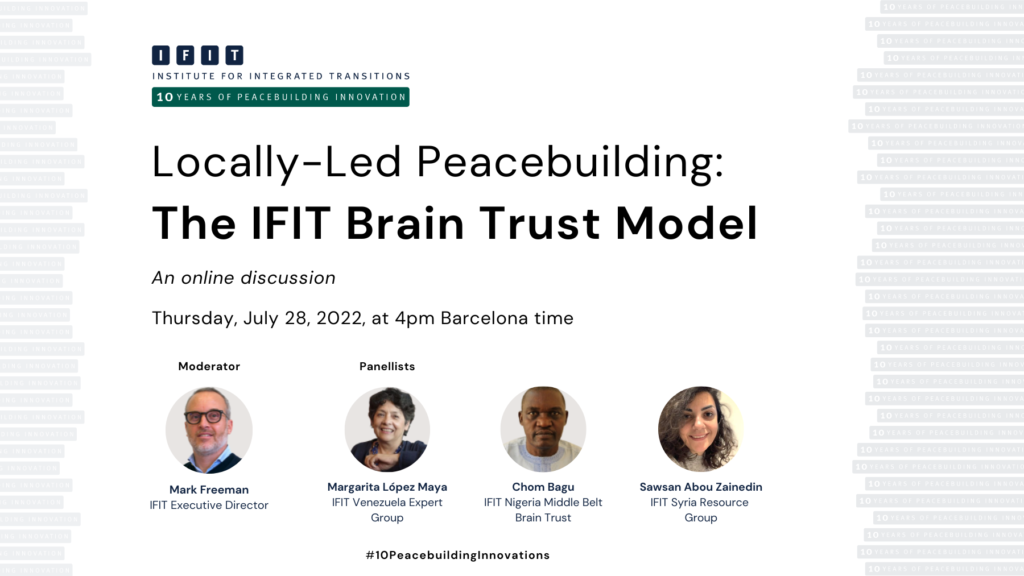
IFIT’s pioneering brain trusts creatively pool and harness the unique strengths of local ‘go-between’ leaders to bridge national and community-level processes of dialogue, peacebuilding and transition.
Global Initiatives
Peace Treaty Initiative
The Peace Treaty Initiative aims to develop new international law to incentivise and support peace negotiations, in order to prevent armed conflicts in the first place and to end them once underway.

Global Initiative on Polarization
The Global Initiative on Polarization, an IFIT collaboration with the Ford Foundation, seeks to advance global understanding of the diverse causes, consequences and realistic strategies for reducing severe polarization and preventing violent conflict.

Initiative on Apex Court Appointments
The Initiative on Apex Court Appointments will fill the current gap in guiding principles – both globally and regionally – in the selection and appointment of constitutional and apex court judges.
Short videos
View all videosOur publications
IFIT conducts and publishes original research to add to the state of knowledge on transitions, identify policy gaps, and provide the most credible analysis and recommendations possible.

View all publications
Publication / Global Initiative on Polarization
First Principles: The Need for Greater Consensus on the Fundamentals of Polarisation
- English
- Español
- Français
- العربية
- Português

Publication / Law and Peace
Partial Agreements: The Functional Alternative to All-Encompassing Settlements
- English

Publication / Inclusive Narratives
Narrative, Power and Polarisation: The Role of Influential Actors
- English
- Español
Publication / Law and Peace
The Scope for Dialogue with Security Forces in Hybrid Regimes
- English
- Español